
To optimize tongue position for ice plunges, rest your tongue gently on the roof of your mouth just behind your front teeth. Keep it steady throughout your exposure, avoiding pressing too hard or letting it fall away. Combine this with slow nasal breaths, focusing on extended exhales, to activate the calming nervous system. Maintaining this technique supports better oxygen flow and reduces panic. Keep practicing, and you’ll discover more ways to stay calm during cold stress.
Why Your Tongue Placement Helps Reduce Cold Stress

Placing your tongue on the roof of your mouth just behind your front teeth plays a crucial role in reducing cold stress during ice plunges. This tongue position stabilizes your airway, encouraging nasal breathing which helps warm and humidify the air you inhale.
It also activates your parasympathetic nervous system, promoting a relaxed state and longer, slower exhales. Controlled breathing becomes easier, preventing rapid, shallow breaths that can spike your heart rate and trigger panic.
How to Find the Right Tongue Position for Ice Plunges
To find the right tongue position, gently place it on the roof of your mouth just behind your front teeth and keep it there throughout your ice plunge. A proper tongue posture can also support diaphragmatic breathing and help regulate your oxygen intake during cold exposure. Be mindful of common mistakes like pressing too hard or letting the tongue fall away, which can disrupt your breath control. Practicing this position consistently helps stabilize your breathing and enhances your ability to stay calm during cold exposure.
Optimal Tongue Placement
Finding the right tongue position during ice plunges begins by gently resting your tongue on the roof of your mouth, just behind your top front teeth. This placement supports nasal breathing, helping you take slow, deep breaths.
As you inhale through your nose, the tongue’s position keeps your airway open, encouraging belly and rib expansion for better oxygen intake. During exhale, this steady tongue placement promotes calm, controlled breathing, activating your parasympathetic nervous system. It also prevents mouth breathing, reducing hyperventilation and irregular breaths in cold water.
Consistently practicing this tongue position before and during your immersions builds a natural, stable breath pattern. This stability helps you stay focused and composed, making the cold stress easier to manage. Effective recovery tracking apps can assist in monitoring your breathing and heart rate during cold plunges to optimize your responses.
Common Position Mistakes
Many people struggle with maintaining the correct tongue position during ice plunges, which can unintentionally undermine your breath control. A common mistake is letting your tongue rest low in your mouth or touching the bottom teeth, encouraging mouth breathing and making it harder to manage your breath during cold hits.
Another error is pressing your tongue too far forward against the teeth or too far back on the soft palate, causing discomfort or airflow disruption. When your tongue isn’t properly positioned, your breath may become irregular, increasing panic reflex during the cold shock response.
To avoid these pitfalls, practice placing your entire tongue gently against the roof of your mouth, just behind your front teeth. This helps regulate your breath and maintain calmness, even when the cold hits hard. Additionally, selecting adaptogen products that support stress response can further enhance your ability to stay calm during cold plunges.
Enhancing Breath Stability
Positioning your tongue correctly is key to stabilizing your breath during ice plunges. When you gently press your tongue against the roof of your mouth, just behind your upper front teeth, you naturally promote nasal breathing and keep airflow steady during cold water immersion. This position helps maintain an open airway, supporting slow, deep breaths that combat the cold shock’s rapid breathing reflex. Activating the vagus nerve through this tongue placement relaxes your heart rate and calms panic responses. Practicing controlled tongue positioning before and during your plunge improves breath consistency and boosts your cold tolerance. Combine this with breathing techniques like 4-7-8 or box breathing to maximize control. Here’s how it feels:
| Calm | Anxious |
|---|---|
| Stable, deep breaths | Shallow, rapid breathing |
| Relaxed heart rate | Elevated heart rate |
| Sense of control | Feelings of panic |
| Confidence in cold dive | Hesitation or dread |
Practicing Tongue and Breath Control for Cold Calmness
To cultivate cold calmness, focus on maintaining proper tongue placement and controlled breathing. Practice slow, nasal inhales for 3-4 seconds and extended exhales for 6-8 seconds to stay relaxed and conserve heat. Consistently combining these techniques trains your nervous system to better handle cold stress with greater ease. Incorporating sensor accuracy considerations during your training can further enhance your ability to monitor and respond to physiological changes in cold environments.
Proper Tongue Placement
Placing your tongue gently on the roof of your mouth, just behind your top front teeth, is a simple but effective way to enhance breath control during cold exposure. An ice bath can help reinforce this habit, encouraging deep breaths and steady nasal breathing.
This technique also benefits from the perfusion index, which can help monitor blood flow changes during cold stress and ensure stable oxygen levels. Maintaining this position keeps your airway open, allowing for slower, controlled inhalations that activate the vagus nerve, promoting relaxation.
Maintaining this position signals safety to your brain, reducing panic and hyperventilation.
Consistently practicing this technique helps improve focus and breath rhythm, supporting smooth shifts during breathing exercises like 4-7-8. When your tongue rests correctly, it becomes easier to manage your response to cold shock and extend your ice plunge, ultimately building your cold tolerance while staying calm and centered.
Coordinated Breathing Techniques
Practicing coordinated breathing techniques that involve both tongue placement and breath control can greatly enhance your calmness during cold exposure.
When you consciously control your breath and position your tongue on the roof of your mouth, just behind your front teeth, it helps regulate airflow and promotes nasal breathing. This is especially beneficial during an ice or cold plunge, as it signals safety to your brain, activating the parasympathetic response.
Using methods like the 4-7-8 breathing pattern, combined with tongue positioning, creates a steady, calming rhythm that reduces the cold shock reflex and hyperventilation.
Pre-practicing these techniques before immersion preps your nervous system, enabling longer, smoother exhalations, activating your vagus nerve, and conserving heat—making cold plunges more manageable.
Engaging in these controlled cold therapy practices helps condition your body to tolerate cold exposure better over time.
Common Mistakes When Using Tongue Position During Cold Exposure

One common mistake during cold exposure is neglecting to maintain the correct tongue position, which can disrupt nasal breathing and weaken breath control. When your tongue isn’t resting gently on the roof of your mouth behind the top front teeth, you risk shallow, irregular breathing, triggering the fight-or-flight response.
This hampers deactivation needed for calm, especially during box breathing exercises. Tensing your jaw or tongue can also increase muscular tension, making it harder to slow your intake of air.
Be mindful to:
- Keep your tongue resting on the palate for ideal breath flow
- Avoid tensing muscles that can hinder relaxation
- Pair proper tongue position with calm, nasal inhalations
This helps maintain steady breathing and prevents hyperventilation, supporting cold tolerance.
Tips to Stay Consistent With Tongue and Breathing Techniques
Are you looking for effective ways to maintain consistent tongue and breathing techniques during cold exposure? Incorporate a pre-plunge routine that combines mindful tongue position with box breathing or similar slow, controlled breaths like 4-7-8. Keep your tongue resting gently on the roof of your mouth behind the top front teeth to promote nasal breathing, which helps control your cold response. Use tactile reminders, such as lightly touching the roof of your mouth with your tongue, to reinforce proper positioning. Tracking your breath count and noting tongue placement during each session builds muscle memory, making it easier to stay consistent over time. Additionally, choosing a reliable interval timer can help you manage your breathing intervals precisely during your practice. Practice regularly, and you’ll develop better cold therapy tolerance and more controlled, calming breaths during ice plunges.
How Tongue Position Promotes Relaxation in Ice Baths
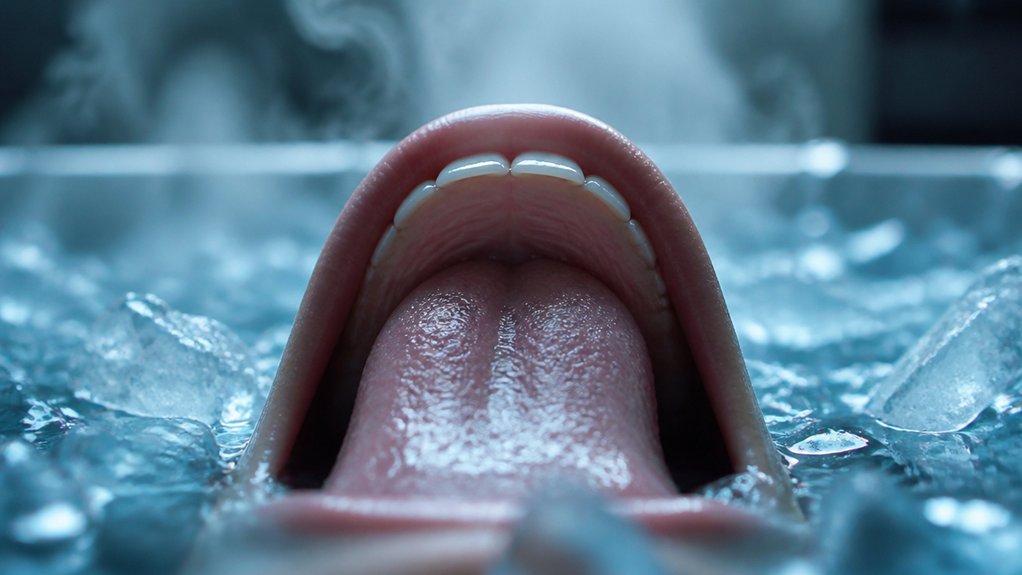
Proper tongue placement during an ice bath plays a crucial role in promoting relaxation by activating your body’s calming mechanisms. When you place your tongue on the roof of your mouth behind your top front teeth, it helps regulate your breathing and signals safety to your nervous system. This technique can also support a calming environment by encouraging the use of durable materials that withstand moisture and temperature fluctuations in cold plunge spaces.
Proper tongue placement activates calming nervous system responses during cold exposure.
This supports smoother, slower nasal breathing, which aids in managing the cold shock response and reducing panic.
To enhance relaxation:
- Practice Box Breathing syncing it with your tongue position to calm your mind.
- If you need to hold your breath maintain your tongue contact to control your breath more effectively.
- Breathe slowly through your mouth when necessary, keeping your tongue on the palate for better breath control and mental focus.
Combining Tongue Placement With Breathing Techniques for Better Results
Combining effective tongue placement with structured breathing techniques enhances your ability to stay calm and centered during cold exposure. When you place your tongue on the roof of your mouth behind the front teeth, it encourages nasal breathing, which is essential during ice baths. Pairing this with techniques like Box Breathing or a long exhale deepens vagal stimulation, helping you control your response to cold stress. This combination signals safety to your brain, activating your parasympathetic nervous system, reducing the cold shock response, and improving breath control. Use the table below to optimize your practice:
| Technique | Impact |
|---|---|
| Box Breathing | Regulates airflow, calms mind |
| Long Exhale | Activates relaxation, enhances cooling |
Supporting Your Cold Tolerance and Recovery With Tongue and Breath
Supporting your cold tolerance and recovery depends greatly on how effectively you use your tongue and breath control during and after cold exposure. By positioning your tongue on the roof of your mouth behind your top front teeth, you help regulate breath flow and activate your parasympathetic nervous system, boosting cold resilience.
Proper tongue placement and breath control enhance cold resilience and recovery.
Incorporate box breathing with an extended exhale, deeply through your nose, to calm your nervous system and manage the cold shock response. Consistently practicing this helps maintain steady diaphragm function, increasing oxygen efficiency, and supporting recovery.
Consider these techniques:
- Use tongue placement to encourage nasal breathing during cold exposure.
- Focus on extended exhale to promote relaxation and stress reduction.
- Implement box breathing to reinforce calmness and control hyperventilation.
Frequently Asked Questions
How to Prepare Breathing for a Cold Plunge?
To prepare your breathing for a cold plunge, focus on slow, deep nasal inhales while pressing your tongue gently on the roof of your mouth, then exhale steadily to calm your nervous system and promote relaxation before immersion.
What Is the Correct Position of the Tongue When Breathing?
You should gently place your tongue against the roof of your mouth, just behind your upper front teeth. This position keeps your airway open, encourages nasal breathing, and helps you stay calm and focused during ice plunges.
Can Cold Plunge Lower Cortisol?
Yes, cold plunges can lower cortisol levels. You activate your parasympathetic nervous system through controlled breathing during cold exposure, which reduces stress hormones over time. Focused breathwork helps maintain this calming effect, improving resilience.
Can Cold Plunge Cause AFIB?
Cold plunges can trigger AFib in susceptible individuals due to sudden cardiovascular stress, increased adrenaline, and blood vessel constriction. If you have a heart condition, consult your doctor and use controlled breathing techniques for safer cold exposure.