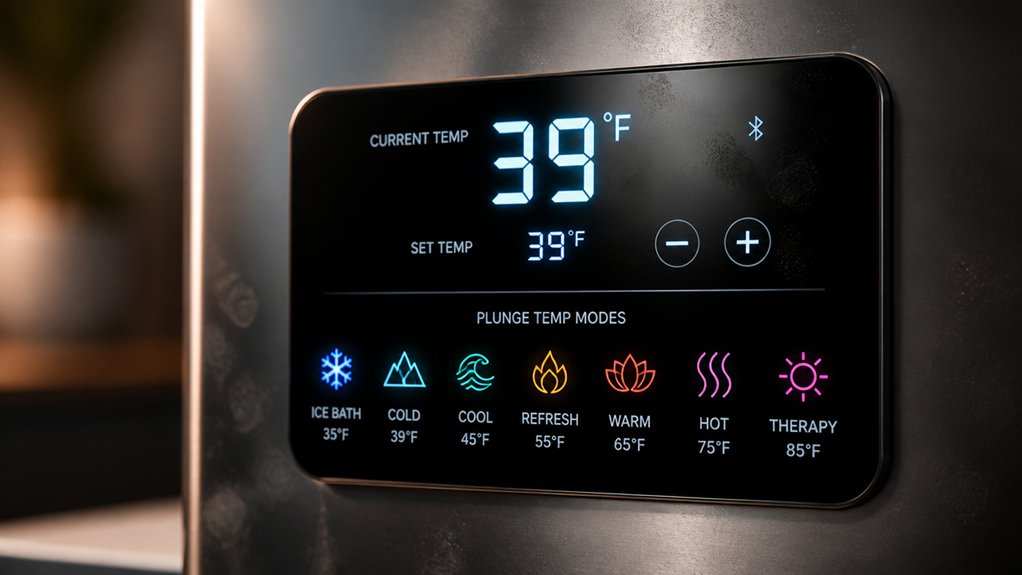
To optimize your plunge temperature control, focus on seven key settings: the target temperature, restart temperature (F01), standby points, and water flow. Proper calibration of F01 guarantees stable cycling and prevents unnecessary wear. Avoid adjusting F02 during normal operation to keep temperature display accurate. Maintaining water temps between 50-55°F guarantees safety and efficiency. Consistently monitor and fine-tune these settings to extend your chiller’s lifespan and achieve reliable performance; there’s much more to learn for best results.
Getting to Know Your Chiller’s Key Temperature Settings
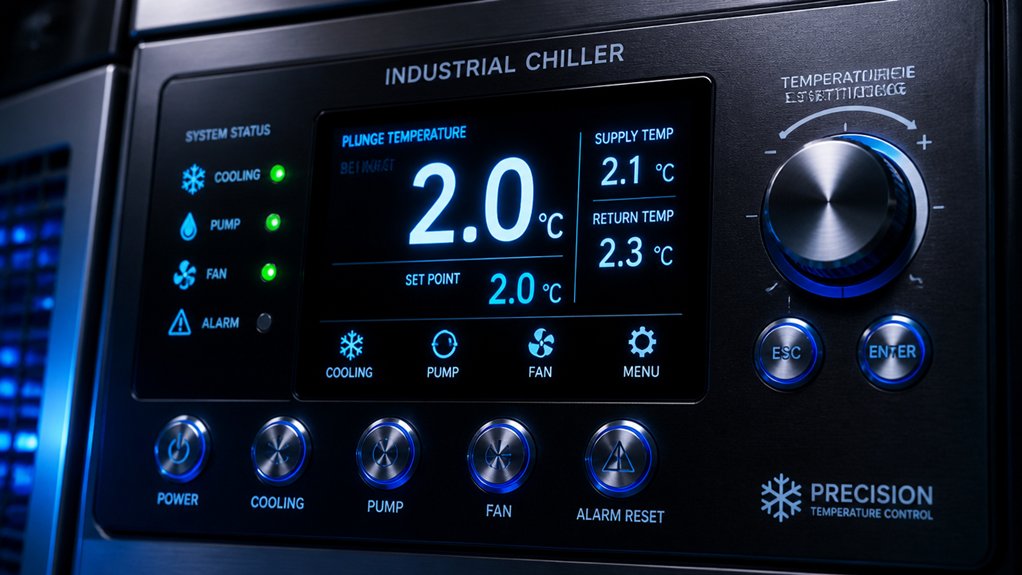
Have you ever wondered how your Plunge chiller maintains a stable temperature? It all revolves around key settings like F01. This setting controls the temperature range at which your chiller restarts after reaching the target temperature.
For example, if you set F01 to 2°C with a target temperature of 5°C, the chiller will restart once the water temperature hits 7°C. Adjusting F01 changes how often the system cycles, influencing both energy efficiency and temperature stability.
Additionally, selecting a high-powered chiller with compressors from 1/3 HP to 1 HP can provide rapid cooling and better temperature regulation, especially for larger pools. A proper F01 setting guarantees your chiller maintains consistent cooling without unnecessary on/off cycles. Avoid tinkering with F02, as it’s mainly for repairs and can cause temperature display errors if misadjusted.
Understanding how F01 impacts temperature regulation helps you keep your chiller operating smoothly.
How to Adjust and Calibrate Restart and Standby Temperatures
To effectively manage your chiller’s cooling cycle, you need to know how to adjust and calibrate the restart and standby temperatures.
The F01 setting controls the restart temperature, which determines how many degrees above the set point the chiller will reactivate. For example, with F01 at 2°C and a set temperature of 5°C, the chiller will restart at 7°C.
F01 sets the temperature difference before the chiller restarts, ensuring precise control and efficient operation.
Proper calibration guarantees consistent temperature control and prevents chiller wear. When adjusting, consider these key points:
- Lowering the F01 increases cycling frequency, which can improve stability but may cause more wear.
- The chiller enters standby mode when water reaches the set temperature, remaining off until the temperature exceeds the F01 restart range.
- Avoid modifying the F02 setting unless needed for repairs, as it can cause shutdown issues or display errors.
- Ensuring accurate temperature readings and calibration can extend the lifespan of your cooling system and maintain optimal performance.
Controlling Chiller Temperature Cycling for Better Performance
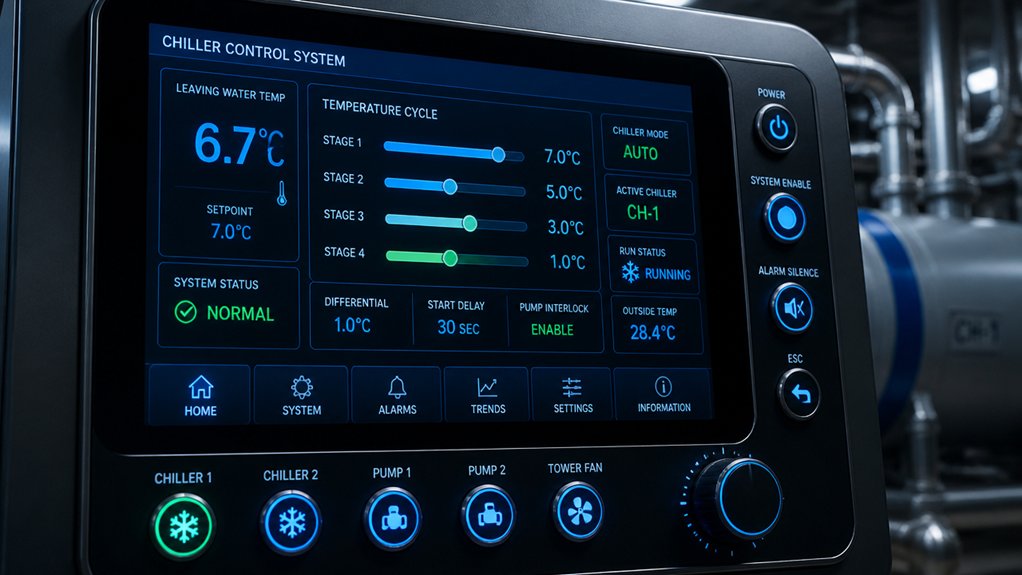
Controlling your chiller’s temperature cycling is essential for optimizing performance and extending equipment lifespan. Adjusting the F01 setting helps manage the restart temperature range after cooling, guaranteeing stable cycle patterns. For example, setting F01 to 2°C with a target temperature of 5°C means the chiller won’t restart until water warms to 7°C, reducing excessive on/off cycling. Lowering the F01 increases cycling frequency, which can strain the system and reduce efficiency. Proper F01 adjustment promotes consistent temperatures and smooth cycling, improving energy use and maintaining stable plunge temperatures. Another important aspect is ensuring the matching water volume and chiller capacity to prevent undue strain or temperature drift, as recommended in filter and pump specifications. Avoid changing the F02 setting during normal operation, as it’s meant for repairs.
Troubleshooting Common Chiller Settings Issues
If your chiller isn’t maintaining accurate temperatures or seems off, check for calibration errors and verify the app’s connectivity.
Issues with temperature readings may stem from calibration mistakes, while app sync problems can interfere with control settings.
Ensuring proper calibration and stable WiFi connection helps prevent miscommunications and improves overall performance.
Temperature Calibration Errors
Temperature calibration errors often stem from incorrect F02 settings, leading to mismatched readings and unexpected chiller shutdowns. These errors compromise the goal of precise temperature control, making it difficult to maintain consistent cold plunge sessions.
Misconfigured F02 settings can cause the displayed temperature to differ considerably from the actual water temperature, impacting performance. To troubleshoot:
- Verify the F02 setting matches manufacturer specifications.
- Follow the proper calibration procedures carefully.
- Recheck after adjustments to confirm accuracy.
Since the F02 setting is mainly for repair, avoid unnecessary changes, as incorrect modifications can worsen calibration issues. Restoring proper F02 configurations guarantees stable temperatures and prevents cycling irregularities, supporting reliable operation and peak plunge experiences. Proper compressor operation is crucial for maintaining the desired temperature, especially in quiet and energy-efficient chillers.
Connectivity and App Sync
Connectivity and app synchronization issues often arise when F01 and F02 settings aren’t properly configured. If F01, which controls the chiller restart temperature, isn’t set correctly, the chiller may not restart within the appropriate temperature range, causing discrepancies between the displayed and actual chiller temperature.
This mismatch can lead to premature shutdowns and hinder data syncing with the app. To troubleshoot, verify that F01 is set correctly— for example, F01=2°C when your set temp is 5°C with a restart at 7°C. F02 should typically remain unchanged for normal operation. Additionally, ensuring that the control interface and firmware are up-to-date can significantly improve connectivity and synchronization.
Maintaining proper F01 settings guarantees accurate app readings, smooth connectivity, and consistent data refresh. Firmware updates and the app’s step-by-step instructions can further assist in resolving these common issues.
When and Why to Modify Settings During Repairs
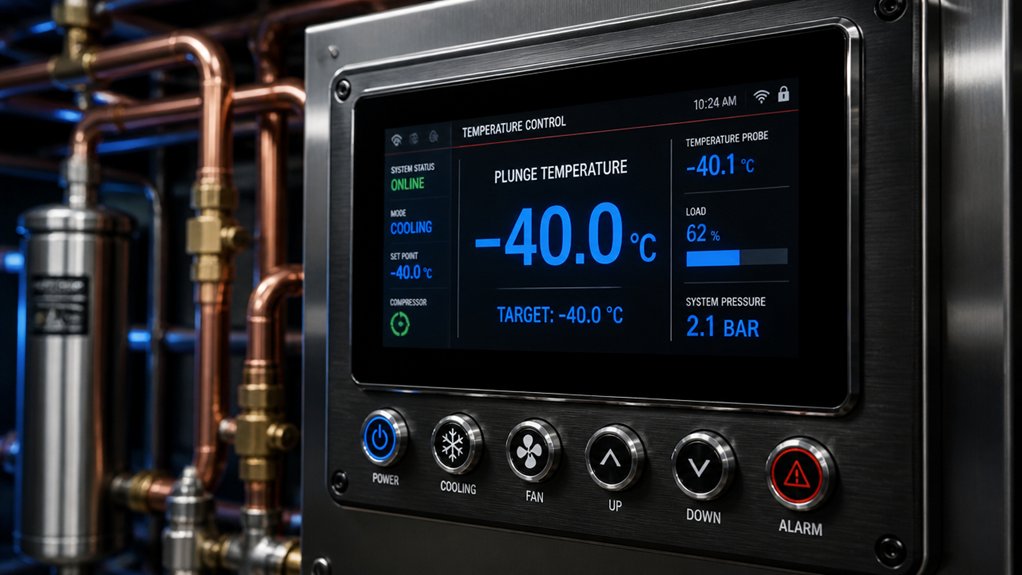
You should only modify the F02 setting during repairs when instructed by service guidelines, such as correcting temperature discrepancies.
It’s vital to follow safety protocols to prevent malfunctions or safety hazards during adjustments.
Proper timing guarantees the system remains stable and that you don’t inadvertently cause further issues.
Timing Adjustments for Repairs
Have you ever wondered when it’s appropriate to modify the F02 setting on the Plunge chiller? You should do so only during repair or troubleshooting, specifically to correct temperature display errors that cause premature shutdown.
Adjusting F02 at the wrong time can create a mismatch between the actual water temperature and what’s shown on the display, leading to operational issues. Timing adjustments during repairs involve calibrating F02 so the chiller restarts accurately after reaching the target temperature.
Keep in mind:
- F02 changes are reserved for repair scenarios, not normal operation.
- Proper calibration guarantees stable temperature control.
- Incorrect timing can trigger unnecessary shutdowns or early deactivation.
- Using a stable and accurate thermometer during calibration ensures precise adjustments and prevents further discrepancies.
These adjustments help maintain reliable performance and prevent disruptions caused by faulty temperature display readings.
Safety Protocols During Modification
Modifying the F02 setting during repairs must be done with strict adherence to safety protocols because incorrect adjustments can lead to system instability and inaccurate temperature readings. You should only change the F02 chiller setting during troubleshooting or maintenance, as improper tweaks may trigger premature chiller shutdowns or disrupt water temperature control. Additionally, understanding the temperature control system is crucial to avoid unintentional malfunctions during adjustments.
The F01 setting, which manages restart temperature ranges, should remain unchanged during normal operation to guarantee consistent cycling. Safety protocols emphasize avoiding F02 adjustments under regular conditions, as these changes can cause system errors affecting user safety.
Always follow manufacturer guidelines closely, guaranteeing precise modifications. Proper adherence prevents unintended disruptions, maintains stable cold plunge temperatures, and safeguards against risks associated with improper water temperature management.
Tips for Keeping Cold Water Temperatures Stable and Safe
Maintaining stable cold water temperatures is essential for maximizing therapeutic benefits and ensuring safety. To achieve this, you must focus on proper control and tank setup.
First, use calibrated digital thermometers with ±0.5°F accuracy to monitor water temperature accurately. Proper water circulation prevents temperature stratification and uneven chilling, which can compromise therapy.
Consider these tips:
- Keep water temperature within 50-55°F (10-13°C) to optimize results and reduce hypothermia risk.
- Avoid setting an excessively low restart range (F01) to minimize temperature fluctuations and maintain consistent control.
- Regularly check chiller behavior, and only modify F02 settings when troubleshooting to prevent premature shutdowns.
Good tank setup and diligent control are key to consistent, safe cold water temperatures.
How Proper Settings Can Extend Your Chiller’s Lifespan
Properly configuring your chiller settings plays a key role in extending its operational life. Setting the F01 parameter correctly guarantees your chiller maintains a stable restart temperature range, minimizing unnecessary cycling that causes wear.
Avoid adjusting the F02 setting during normal use, as improper changes can lead to premature shutdowns and temperature read discrepancies, stressing internal components.
Maintaining consistent temperature thresholds through proper standby and restart points prevents excessive compressor cycling, reducing mechanical fatigue.
Regularly monitoring and adhering to recommended F01 settings guarantees efficient cooling cycles, avoiding short cycling that accelerates failure.
Operating within manufacturer-recommended temperature ranges is essential for peak performance, preventing overheating or freezing damage.
Proper temperature control directly contributes to your chiller’s longevity, keeping it running smoothly longer.
Frequently Asked Questions
How Long Does Joe Rogan Stay in Cold Plunge?
You stay in the cold plunge for about 4 to 5 minutes per session, starting at 50-55°F, focusing on gradual breath control and mental focus. You also regularly adjust the temperature to improve your adaptation over time.
Is 42 Degrees Too Cold for a Cold Plunge?
Yes, 42°F is too cold for a cold plunge if you’re a beginner. It can cause cold shock and hypothermia risk, so start gradually around 59-60°F and only tolerate colder temps once you’ve adapted and gained experience safely.
Is 64 Degrees Cold Enough for a Cold Plunge?
Yes, 64°F is cold enough for a cold plunge, especially if you’re a beginner. It offers mild benefits, helps build tolerance, and prepares you to handle colder temperatures for more profound physiological and recovery effects over time.
Can You Overdo Cold Plunges?
Yes, you can overdo cold plunges by plunging too cold, too long, or too often without gradual progression. This increases hypothermia and health risks, so stick to moderate, consistent sessions, and always listen to your body’s signals.