
To prepare for ice baths, focus on breathing techniques that calm your nervous system and build tolerance. Use deep diaphragmatic breathing to slow your breath and activate the vagus nerve, helping you relax. Practice box breathing to control anxiety and reduce cold shock. You can also try the 4-7-8 method to deepen relaxation, or physiological sighs to increase cold resilience. Mastering these methods can make cold exposure safer and more effective—discover more strategies to optimize your practice.
Why Breathing Is Essential Before Cold Exposure
Before immersing yourself in cold water, controlling your breathing is crucial because it helps manage your body’s natural fight-or-flight response. Controlled breathing calms your nervous system, preventing panic-induced hyperventilation caused by cold shock.
By consciously slowing your breath, you regulate the parasympathetic nervous system, which promotes relaxation and recovery. This process stimulates the vagus nerve, helping to lower your heart rate and conserve body heat. Establishing a steady, calming breathing pattern before cold exposure reduces initial shock and stress, gradually building your cold tolerance over time.
Additionally, focused breathing enhances lung capacity and oxygen efficiency, indispensable for maintaining stability amid rapid physiological changes. Proper breath control guarantees you stay calm, centered, and prepared for the challenges of cold exposure. Proper resistance control and breathing accuracy are essential for optimizing your preparation.
How to Practice Deep Diaphragmatic Breathing for Ice Baths
Practicing deep diaphragmatic breathing for ice baths involves a deliberate focus on slow, controlled breaths that promote relaxation and calmness. To start, inhale slowly through your nose for about 4 seconds, concentrating on expanding your belly rather than your chest. Use this table to understand key points:
| Focus Area | Technique |
|---|---|
| Breath control | Inhale slowly, hold briefly, then exhale fully |
| Engaging the diaphragm | Place one hand on the chest, the other on the belly |
| Maintaining calm | Exhale longer than inhale to relax during ice baths |
Additionally, incorporating pH-balanced cleansing agents into your post-ice bath routine can help support the skin’s natural barrier and reduce irritation.
Mastering Box (Square) Breathing to Reduce Cold Shock and Anxiety

Mastering box breathing helps you control your breathing rhythm, keeping it steady during cold exposure. As you focus on each square, you’ll reduce anxiety and stay calm amid the shock of the cold water. This practice also minimizes the cold shock response, making your ice bath experience safer and more manageable. Using a pulse oximeter to monitor your SpO2 levels during sessions can further ensure stability and safety.
Controlling Breathing Rhythm
Controlling your breathing rhythm with box breathing is a powerful way to manage cold shock and anxiety during ice baths. By maintaining four equal phases—inhale, hold, exhale, hold—you create a steady, rhythmic pattern that calms your nervous system.
This practice slows your breathing from the rapid, shallow pattern triggered by cold exposure, reducing panic. The controlled counts and pauses stimulate your parasympathetic nervous system via the vagus nerve, enhancing relaxation and heat preservation. Utilizing devices with guided breathing modes and visual cues can further support breath synchronization and consistency.
Visualizing a square during each cycle helps keep your focus, preventing your mind from fixating on discomfort. Maintaining consistent box breathing not only eases immediate stress but also boosts lung capacity, improves oxygen intake, and strengthens mental resilience over time, making cold exposure more manageable.
Enhancing Calmness and Focus
Enhancing calmness and focus during ice baths relies on the steady rhythm of box breathing, which acts as a mental anchor amid cold-induced discomfort.
Practicing breath control through four equal stages—inhale, hold, exhale, hold—guides your mind away from anxiety and maintains alertness. This technique activates the parasympathetic nervous system, calming your fight-or-flight response triggered by cold water.
As you focus on counting and maintaining the rhythm, your attention shifts from physical discomfort to steady breathing, sharpening your mental clarity. Mastering box breathing not only fosters relaxation but also improves oxygen efficiency, allowing you to stay composed and prolong your ice bath sessions.
This mindful approach helps you develop resilience against cold stress and maintain focus throughout the experience. Incorporating recovery tracking apps can further support your progress by providing insights into your physiological responses and recovery patterns.
Minimizing Cold Shock Response
Using box breathing during ice baths can greatly reduce the cold shock response by calming your nervous system. This breathing technique helps you engage the parasympathetic nervous system, which counteracts the fight-or-flight reaction triggered by sudden cold exposure. Practicing this method before and during ice baths trains your body to resist gasping, hyperventilation, and anxiety. It slows your breathing, ensuring more controlled, steady inhales and exhales, which optimize oxygen intake. To visualize, consider this table:
| Phase | Duration | Effect |
|---|---|---|
| Inhale | 3-4 sec | Opens airways, calms nerves |
| Hold | 3-4 sec | Reinforces rhythm, reduces panic |
| Exhale | 3-4 sec | Activates parasympathetic system |
Mastering box breathing fosters mental focus and physical relaxation, minimizing ice-induced shock. Incorporating proper breathing techniques can significantly enhance your acclimation process and improve your overall cold exposure experience.
Using 4-7-8 Breathing to Calm Your Nerves During Cold Dips
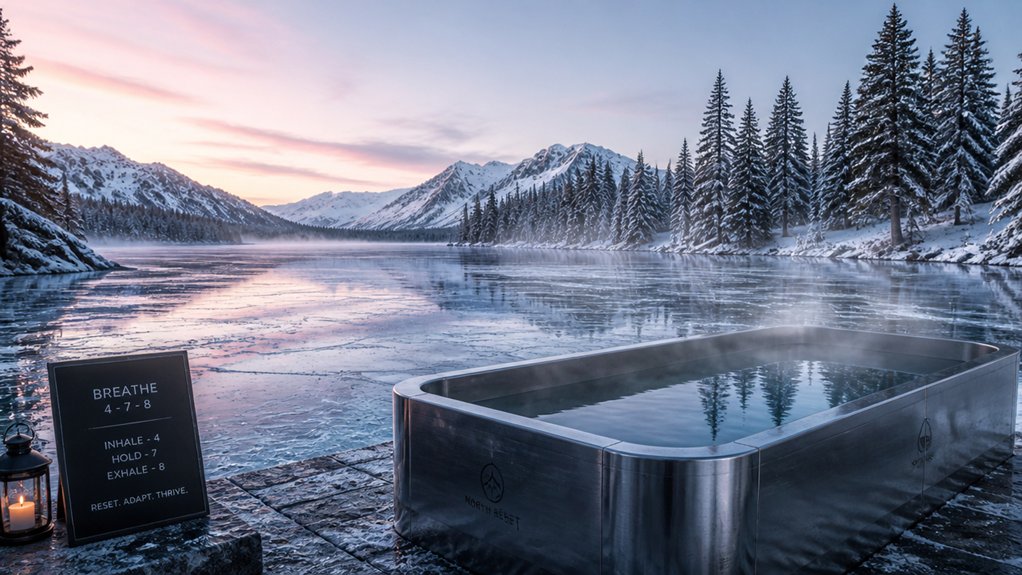
Using the 4-7-8 breathing technique during cold dips helps calm your nervous system and trigger a relaxation response. It slows your heart rate and lowers blood pressure, counteracting the stress of cold immersion. Incorporating adaptogens like ashwagandha or Rhodiola can further support your stress resilience and enhance your cold tolerance. Regular practice also boosts your cold tolerance and mental focus.
Calms Nervous System
When you step into cold water, your nervous system quickly reacts with a fight-or-flight response that can feel overwhelming. The activation of your sympathetic nervous system raises your heart rate and heightens anxiety.
The 4-7-8 breathing technique helps calm this response by stimulating your parasympathetic nervous system, which counteracts stress. By inhaling for 4 seconds, holding for 7 seconds, and exhaling slowly for 8 seconds, you signal your body to relax.
This controlled breathing not only promotes deep relaxation but also reduces your heart rate, easing the initial shock of icy water. Regular use of 4-7-8 breathing strengthens your nervous system’s resilience, empowering you to stay calmer during cold dips and manage stress more effectively. Incorporating techniques like sensor accuracy under cold stress ensures a comprehensive approach to maintaining safety and control during cold exposures.
Promotes Relaxation Response
During cold dips, the sudden shock can trigger a surge of anxiety and rapid breathing, making it hard to stay calm. The 4-7-8 breathing technique activates your parasympathetic nervous system, signaling your body to relax.
By inhaling for 4 seconds, holding for 7, and exhaling slowly for 8, you slow your heart rate and lower blood pressure, counteracting cold-induced hyperventilation. This pattern quiets distracting thoughts, helping you stay mentally focused during ice baths.
Regular practice reinforces breath control, improving oxygen efficiency and making cold dips feel more manageable. Using 4-7-8 breathing encourages a relaxation response, transforming a stressful situation into an opportunity for calm and resilience.
This technique becomes a valuable tool to stay centered amid the cold.
Enhances Cold Tolerance
Practicing the 4-7-8 breathing technique before and during cold dips can greatly enhance your cold tolerance by calming your nervous system. This method activates the parasympathetic nervous system, which promotes relaxation and counters the cold shock response.
During cold water immersion, the extended exhale in 4-7-8 breathing helps lower your heart rate and regulate breathing, making longer, more comfortable immersions possible. It also encourages vagus nerve activation, supporting heat conservation and reducing hyperventilation.
Regular use strengthens your breath control and mental resilience, gradually increasing your ability to handle cold exposure. By calming your nerves during cold dips, the 4-7-8 breathing technique makes cold water immersion less overwhelming and more manageable, helping you build tolerance over time.
Physiological Sighs: A Simple Technique to Improve Cold Tolerance
Physiological sighs are a simple yet powerful breathing technique that can greatly boost your cold tolerance. By practicing this method, you help improve your breath control, increasing lung volume with two quick inhales—one long, one short—followed by a slow, extended exhale.
This pattern efficiently expels carbon dioxide, reducing the urge to breathe during cold water immersion. When you perform physiological sighs before and during ice baths, you activate your parasympathetic nervous system, aided by the vagus nerve, which promotes relaxation and calmness.
Regular practice strengthens your ability to manage cold-induced stress, building resilience over time. Incorporating slow, controlled exhalations with physiological sighs allows for better oxygen utilization, making cold exposure more manageable and comfortable.
How Controlled Breathing Boosts Cold Adaptation and Recovery
Controlled breathing plays a crucial role in enhancing your body’s ability to adapt to cold exposure and recover afterward. During Cold Therapy, techniques like Wim Hof breathing help regulate your fight-or-flight response by slowing and deepening your breaths, which boosts oxygen intake and reduces panic.
Breath control also activates your vagus nerve, triggering the parasympathetic nervous system, promoting relaxation, and conserving body heat. Practicing methods such as box breathing or 4-7-8 breathing increases your lung capacity and oxygen efficiency, supporting longer cold water immersions.
Consistent regulation of your breath during ice baths builds mental resilience and physical adaptation by minimizing irregular breathing and hyperventilation. Ultimately, controlled breathing speeds recovery by lowering stress-induced inflammation and strengthening parasympathetic nervous activity, helping you bounce back faster from the cold.
Step-by-Step: The Wim Hof Breathing Method for Cold Preparation
| Step | Action |
|---|---|
| Deep breaths | Inhale through nose, exhale through mouth |
| Breath hold | Hold until urge to breathe returns |
| Full inhale | Take a deep breath, hold again |
| Repeat | Complete 3-4 rounds |
Tips for Maintaining Your Breathing Practice Over Time
Maintaining your breathing practice over time requires consistency and intentional effort. To help build strong habits, practice controlled breath techniques like box breathing or diaphragmatic breathing before and during each ice bath session. Deep, mindful breaths can help improve lung capacity and build cold tolerance.
Set aside dedicated time regularly, ideally daily or several times a week, to focus on your breath awareness. Using visual cues or breathing apps can help maintain rhythm and prevent your mind from wandering, ensuring you stay engaged.
Track your progress and responses to cold exposure to identify what works best and adjust routines accordingly. Gradually increase breath hold durations and complexity, but always listen to your body to avoid discomfort or hyperventilation.
Frequently Asked Questions
How to Breathe Before an Ice Bath?
Before an ice bath, you should take 3-4 slow, deep breaths through your nose, inhaling for about 3 seconds and exhaling for 6, to relax muscles, reduce gasp reflex, and calm your nervous system.
What Is the 4 4 4 4 4 Breathing Pattern?
The 4-4-4-4-4 breathing pattern involves inhaling, holding, exhaling, and holding again, each for four seconds. You maintain a steady, rhythmic pattern to promote relaxation, control stress, and improve oxygen efficiency during cold exposure or ice baths.
Can Cold Plunge Lower Cortisol?
Cold plunges can lower cortisol levels by activating your parasympathetic nervous system through controlled breathing, reducing stress responses, decreasing inflammation, and promoting mood improvements over time. Regular exposure amplifies these benefits, supporting overall stress management.
Can Ice Baths Help With Lipedema?
Ice baths may help with lipedema by reducing inflammation, improving lymphatic drainage, and promoting circulation. Incorporate controlled breathing techniques to enhance cold tolerance and circulation benefits, but always consult your healthcare provider before starting this therapy.